Thursday, March 27, 2014

Artscience (Part 1): How do we define this weird thing?

Many luminaries of the European Renaissance toed the line between science and art. You're of course thinking about Leonardo Da Vinci right now, because of course. But "artscience" is hardly a thing of the past, and many scientists and artists now are following that same interdisciplinary approach. As a result, many people have been trying to define this weird concept, and in my estimation, many are failing (please see the resoundingly meh first sally in this realm, Artscience: Creativity in the Post-Google Generation by David Edwards. It was a nice try, but meh). So, I'm now going to try. Artscience: what the hell are you people talking about?

One of the biggest hurdles in defining artscience is that it's so incredibly broad. Are you talking about it as a field of academic research? Are you talking about sciencey art or artsy science? Are you talking about what makes art good? What? I'm going to start my definition by discussing the first question, artscience as a field of academic research. This field can be defined as the examination of the cognitive (and sensory) experience of producing and consuming art. There are a few labs out there researching this concept (like my favorite, the NeuroArts Lab at McMaster University), who are most likely busy all the time (if they can get the funding) because of the vast area that this field encompasses. To research artscience is to research: cognitive function, the evolutionary role of art, how different cultures define art, how we produce different types of art, how we consume different types of art, etc. Too many.

Now how about sciencey art and artsy science (and STEAM)? This is, again, super broad. We can talk about my friend who's an art restorer for the Smithsonian, whose tricky work involves sooooo much chemistry and scientific experimentation in order to avoid doing this:
We can talk about wildlife photographers developing robots to go where people can't go, we can talk about scientists developing new neuroimaging techniques, we can talk about Nikon's Small World competition, we can talk about artists like Guhapriya Ranganathan who produce art inspired by neural structures. Hell, we can even talk about Jackson Pollock. Again, it's so damn broad that we can talk about all of this stuff and get nowhere.

Now onto what makes art good, or appealing. Yes, it's subjective, and yes, it's hard to distill, but is it worth talking about? So we know some things from the realms of art history and sensory perception. We like art that falls under the rule of thirds, we like Escher's art because it plays on the quirks of our sensory system, we like art that makes us feel something. There are even those little quizzes with pictures that are supposed to tell you what kind of person you are based on which one you like the best. "Why do we like some art and not others?" is that "reach" question, much like "what is consciousness?" and once we get past answering the first two questions, maybe neuroimaging and behavioral studies are the answer. 

Don't get me wrong - as a cognitive scientist AND dance artist I love this kind of stuff and am willing to discuss it ad nauseum. But like the cognitive scientist I am, I really want us to truly define what we're looking at before we go any further. 

Stay tuned for the next part of this series, Artscience (part 2): Music. 

Tuesday, November 19, 2013

Pinkifying Science: Where it comes from and why it's ingrained

We've all seen efforts to market products to girls, and they all seem to look like this: paint it pink, give it a girly name, put some relatable pretty girls in the ads, and there you have it.

Case in point.
So it should come as no surprise to see the same approach applied to STEM (science, technology, engineering, and math, in case you weren't sure and have just reached a point where it's gone on too long and you feel weird asking) advocacy. Efforts to tie girly things like cheerleading and makeup to STEM may cause me and other females knee-jerk reactions, but is it as ill-advised an approach as we think (and for the reasons we think)?

It seems that STEM education is in such a dire state that all approaches to advocacy involve some sort of "gloss". Sports, cute things, movies, explosions, etc. are being used to get kids (and adults) interested in STEM. If we unpack this approach, it seems like the more effective approaches scream, "hey, this thing you already like? THAT'S STEM!!!" 

So clearly the assumption is that girls like cheerleading and makeup. And while all us female scientists cry foul at that, because OBVIOUSLY you can like STEM and still keep all your female naughty bits without having cheerleaders tell you that you can, we should remember back to the points in our childhood where we wanted "the girl toy" from our McDonald's Happy Meals and wanted to be just like girly girl Jessica Wakefield from Sweet Valley High. All kids go through a period where they are trying to establish their gender identities, which may lead little girls to wear pink and little boys to join Pop Warner leagues. As stereotypical as it sounds, these kids might go for it and lean into these gender identities...because they think they should. Little boys think they SHOULD play football, have GI Joes, and hate the color pink. Little girls think they SHOULD wear frilly dresses, play with dolls, and only go to the pink aisle in the toy store. 

And therein lies the problem. Just go to any toy store and count the pink aisles. One, maybe two. Now count all the other aisles. Please bear with me while I extricate my eyebrows from my hairline. 

The problem that plagues STEM advocacy for girls is the same problem that plagues toy stores: reduced access. So while girls are stuck playing with "appropriate" toys, namely dolls, that encourage them to nurture and beautify, boys play with:
  • action figures
  • Nerf and other toy guns
  • Legos and other building toys
  • Transformers (anyone who says that they're the same thing as action figures is going to have a punch in the face, courtesy of me)
  • Big Wheels and other vehicles
  • etc.
But wait, you say, can't girls play with these things too (the same question applies to boys playing with dolls)? Of course, and they do, but chances are they're going to be discouraged by parents, peers, and in time they'll internalize all of that and start discouraging themselves, and go ahead and ask for that pink doll (I'm sorry, I never really had dolls, so I assume that's a thing.) The problem is sociiiiiiiiietyyyyyy, maaaaan. 

The same applies to STEM advocacy. OF COURSE girls and women can like sports, movies, explosions, video games, projectile weaponry (some of my favorite things, actually)...and STEM. STEM advocacy groups just need to increase female access to ALL narratives, to break down these SHOULDS that originate in childhood. Show us a woman who designs video games, builds weapons, crunches numbers for a pro sports team, etc. And at the same time, show us a man who's a nurse or social worker. No part of STEM is off limits to ANY gender. 


Except maybe dildo model. Is that STEM?

Tuesday, March 19, 2013

De-Extinction: A New Hope for Wonder

It made me laugh, alright?

I recently had the opportunity to attend TEDxDeExtinction in DC, an event that brought together conservation biologists, synthetic biologists, and others to discuss reviving and restoring extinct species. Since the event, the response has been overwhelmingly negative, with most people focusing on the process of de-extinction:
1. Finding or generating the extinct organism's DNA
2. Creating an embryo
3. Finding a suitable surrogate
4. The surrogate gestating the embryo to birth
5. The organism surviving for longer than a few minutes after birth
6. Finding the proper habitat for that organism
7. Repeating the process for several organisms so they're able to reproduce
8. Observing and measuring the effect of their reintroduction on the ecosystem, etc.

Clearly, that's a lot of steps, and clearly, there are many possible points of failure, so picking this process apart is like shooting fish in a barrel, which is what everyone is doing now. But why? I think we must be discussing all of this because it's all we CAN do, because right now? We're pre-step 1.

I posted a while back lamenting the loss of wonder in our society. With the moon landing many many years behind us and all other discoveries and advancements seeming far less glorious in comparison (can we get a little excitement over the Higgs Boson, people being cured of AIDS, and the samples being collected by Curiosity, please?), it's been seeming like we as a society just can't get excited over science anymore. That is, until you walk up to someone and tell them that the work being done by synthetic biologists today might be able to (eventually) bring back the woolly mammoth. Or the dodo. Or the tasmanian tiger. Or the passenger pigeon. I'd be willing to bet that, after they get the requisite Jurassic Park references out of their system, they'd be kind of excited. Maybe even really excited. And the person I was imagining in that scenario is an adult. Try telling that to a kid.

I'm pretty sure that, after you rehinge all your limbs and regain your hearing, you'll find that kid researching their favorite extinct animal, trying to learn as they can process about synthetic biology, and putting together science fair projects about what they've found. They might go and ask their parents for woolly mammoth pajamas, bedsheets, and posters, just like kids in the '60s asked for rockets, astronauts, and robots. And this kid might eventually go to school to become a synthetic biologist.

With all of our talk of the leaky STEM pipeline, I really wonder what there is to gain by squelching the underlying hope of de-extinction. Are we somehow worried that these synthetic biologists FORGOT how to do real science? Y'know, with experimental replication and peer review? Are we worried that this will take funds away from those of us doing "approved" science? Because I gotta tell you, the pot of funding for ALL science is shrinking. Fast. So clearly, efforts to just keep up the status quo and go for applied research the way we have been isn't helping to punt more grants our way.

All I'm asking is for some understanding of how powerful hope and wonder can be in propelling people to do things. Initial skepticism in the absence of data should not be a deterrent; I'm sure there were many people fearing a trip to the moon would yield space invaders or something, and were making arguments like the ones in this article from 1963. But we did it anyways, and look what came of it: technological innovations, increased knowledge, and kids diving headlong into STEM. We need another moon landing, and de-extinction could be it.

Thursday, February 21, 2013

"Do you know Lat Pack?"


Charlotte: Why do they switch the r's and the l's here? 
Bob: Uh... for yuks. You know? Just to mix it up. 
Bob: They have to amuse themselves, 'cause we're not making them laugh. 

Ok, so it's time for me to address a myth that gets on my multilingual neuroscientist nerves, which is illustrated perfectly in the little section of dialogue above, from Lost In Translation. In our little American melting pot, we are confronted with the accents of non-native English speakers every day. While I'm not really going to address the idea that the near misses of the American pronunciation of English shouldn't be the object of ridicule (cause seriously, you try speaking Spanish/Chinese/Korean/Italian and see how you get made fun of. By the Chinese in particular. We're a judgey group), I feel it's important to give context for these near misses.

All humans are born with the ability to understand and produce any language...well...ever. As an infant, you have a full vocabulary of phonemes, which are the smallest component parts of all speech. Phonemes cover everything from the slight changes in mouth openness between an English "m" and "b" to the massive differences between vowel-heavy languages like Japanese and the consonant-heavy South African click languages. For example, in Chinese, we have different melodic tones for all our words. Mandarin Chinese has 4 different tones, known as yin, yang, sang, and chu, and they all carry a different musical note and emphasis (by the way, Cantonese Chinese has 9. I'm sure we're all great at singing). Each of these melodic tones is a different phoneme. As you grow and hear more and more of the same phonemes around you, you lose the ability to hear others. This is all part of a regular "pruning" process your brain goes through - why keep things around that aren't necessary? The pruning takes place pretty early - infants stop responding to other-language phonemes at about 6 months of age. 

Once your brain specializes in a language, those phonemes get reinforced. Each time you hear a hard English "b", your brain is reminded of what "b" sounds like. Same goes for the rounded English "r" and the lilting English "l". You start to expect those phonemes. So when you hear a lilting Japanese "r", and a rounded Japanese "l", they deviate so much from your understanding of r-ness and l-ness that you think they must be switched. Truth is, they're both just far closer to neutral than you expect. 


*Note: this is not scientific in any way, just a visual representation of my point.
Now, while it looks like they're not that far apart, one of the things this graphic doesn't capture is how reinforced your native phonemes are. Because your understanding of the hard American "r" is so reinforced that you expect a certain type of "r"-ness, the distance between the Japanese "r" and the American "r" becomes far more pronounced. This reinforcement/expectation ends up putting the lilting Japanese "r" closer to the American "l" on the spectrum. So, rather than looking at this graphic as a continuous flat plane, imagine the American "r" and "l" being valleys or vortexes. A native speaker would have to travel a farther distance to get from the American "r" to the Japanese "r" than it takes to get from the Japanese "r" to the American "l". The same thing happens with the rounded Japanese "l", which is understood by you as being closer to the American "r". 

So, basically, it's not them. It's you. 

Monday, January 7, 2013

The failures of math education

Last year, I was invited to participate in a panel on STEM careers, where my fellow panelists and I were posed this question: "I hate math. How do I get through it?" I nearly jumped out of my chair in excitement; I've fielded these questions from some of my closest friends and I was certain my fellow panelists had had the same experiences; I was really excited to hear what they had to say. But I have never been more disappointed than when I heard their replies: "Work harder." "Practice more." "Work harder AND practice more."

Of course, nothing against my fellow panelists, each of whom were accomplished scientists, mathematicians, and technology experts. Their only failing was making a singular assumption that is shared by many math educators--to assume that students don't WANT to do math, NEVER want to do math, and simply need to be encouraged to keep plugging away at the tedious, awful chore that is math so they can get to the fun stuff. Sadly, when you get a student who's run up against the same brick wall of math every year without any improvement, or worse, clarity, that's probably a safe assumption to make. But it really really really doesn't have to be this way.

Being someone who straddles the line between science and art, I'm surrounded by both math lovers and math loathers. Many of the math lovers would say they had a predilection for math from an early age (I'd put myself in this group) and just received the appropriate challenges and encouragement throughout their development. Their favorite areas of math fall all over the board (I'm big on algebra, myself). The math loathers are an interesting bunch, because many seem to all fall into a single category: people who only get geometry (and are often pretty dismissive of algebra). In other words, these are individuals who need math to be concrete.

It seems strange that algebra and geometry, two areas of math that cover the same types of functions, might generate such divisive reactions. But when you see this:


c2 = 32 + 42
Solve for c

But then see this: 


I'd be willing to bet you'd see a lot more people who could solve that function after seeing the triangle, because suddenly they can make sense of what that variable is supposed to stand in for. You've taken a completely abstract concept and paired it with something concrete that students can see and understand the reasoning behind (FYI: high school math teacher Dan Meyer has a wonderful TED talk on this very concept here: Dan Meyer: Math Class Needs a Makeover). 

So my humble request of all you math (and STEM) educators out there is to PLEASE understand that there are very straightforward reasons why your students just don't get math, and forcing a single perspective on them is exclusionary and unfair, as is punishing them by having them do more homework because they aren't getting it. Your math curriculum shouldn't exclude concrete thinkers in favor of abstract thinkers for the same reason that you shouldn't exclude students of any race, color, or creed. 

I mean, duh.

Thursday, August 30, 2012

Our lost sense of wonder

Very few people made it past the first four minutes of Pixar's Up without shedding a few tears. The classic story of lifelong love and loss touched more than a few hearts, and while it reached me too, nothing made me cry more than seeing young Carl's face light up at the sight of his hero, the famed explorer.

Why was I crying? At that very moment, I realized that that sense of wonder, awe, hope, and excitement simply doesn't exist anymore for kids growing up in our society. 

Of course, I might be wrong. In fact, I HOPE I'm wrong. I just worry that our new information-based culture doesn't breed that wonder anymore. 

Now you might ask why we need that wonder, why being able to find the answers to all our questions online (or what we think are all the answers) is a bad thing. 

1. Sure we can find all the answers to our questions. But what questions are we asking? 
There is a lot of material out there about how our current culture is building "tribes" of people over the Internet. So while we have access to all the information the world has to offer, we are selectively turning our attention to just a few tribe-minded things. The Fox News tribe won't necessarily interact with the Daily Show tribe, the Christian Science tribe won't foray into the Atheist tribe, and so on. You can probably see the problems that this causes. Interactions between these tribes are getting more and more heated because ideas are bouncing back and forth within them and gaining support, like a positive feedback loop. As a result, we are getting tribes that not only avoid the information and culture of other tribes, they are actively disdainful of them. "How DARE you question my beliefs when my WHOLE TRIBE agrees with me?" With each negative interaction that occurs, our curiosity about things we don't know outside of our tiny little tribes fades. We not only stop asking questions about things we don't know, we stop recognizing they exist. 

2. We don't learn things we don't already know anymore.
Nowadays, we get to pick through the information that we seek out or gets delivered to us. For instance, most of my news feeds involve neuroscience, STEM education, and art in some capacity, usually from sources that I know very well. These are busy feeds, and I usually have more than enough information to process, which leaves little room for anything else. I don't have the energy to seek out other topics like anthropology, archaeology, religion, food, or politics. But when it comes down to it, I SHOULD be seeking out those other topics; I know quite a bit about neuro, STEM, and art...I know next to nothing about those other topics. I can learn a lot from seeking out those other topics. But I don't. So I get to know a lot about a few topics reported from certain sources, and because I'm so full of information by that point, I think I know it all. 

3. We've become arrogant motherf*ckers.
Because when we know everything we think one needs to know, why not be a little proud of it? When all the information that is going to be found forever has been found and just needs to be spread around, the true glory resides solely in reporting. Who cares that the bar for the value of information has been lowered? When you are the one who got to a piece of information that your tribe values first, you WIN. When you make a video of your cat that goes viral, you WIN. When you make up the "Y U NO" meme, you WIN. Having seen many examples of this very thing, the only way we care to contribute to our society is being famous through the least amount of work possible.

4. We have very little to look forward to because we see our world falling apart.
I think that we'd all agree that the political atmosphere of the U.S. is massive disaster; politicians are so far removed from their constituents and so far in the pockets of lobbies and PACs that they often hold conflicting views (even individually) based on whoever is funding their campaigns. The voices of the extremists are becoming more and more audible (thanks, again, to the tribes of the information age), and it seems there's no place for reason or a median voice. As a result, ours is a country that struggles to get anything done when it comes to the ruling body. If the people we put in charge can't get anything done, what's the point of hoping that we can, or holding on to dreams?

All of this factioning, fighting, arrogance, willful ignorance, and exclusivity does nothing but kill wonder. Why wonder about anything if it's going to scare, shock, and maybe even anger me? Why bother to dream when we have all the information about whether that dream is even possible right here in front of us? Why dream of doing anything cool when nobody in MY tribe does anything different than I do, so clearly there's no such thing? What is left to explore that someone I don't know hasn't already explored and become the definitive authority on? Why make the effort to accomplish anything when you could be famous by doing nothing? And why bother, when your hopes get dashed by the ruling body of your country?

So it all comes down to one gigantic concept. MOTIVATION. We are not motivated to seek out new information outside of our tribes. We keep going to the same sources because there is just so much out there. So all of our already-held notions of what we personally and what we as a society are capable of are basically repeatedly validated for us, and we don't want anything else. We don't try because we think there is no point. When the late Neil Armstrong walked on the moon, none of us knew that was possible. None of us knew that humans could do that. And when we all saw it happen in front of our eyes, we started to dream of everything else we could do, stuff that we hadn't even begun to explore. 

You can blame science all you want - science brought us the Internet, science made us skeptical of extraterrestrial life, and science killed the hope of magic wands and wizardry and vampires. But it also brought us the space shuttle. It brought us Neil Armstrong. It brought us Curiosity. And it'll bring us the next thing that will open our eyes to a world we didn't think existed. We just need to keep our eyes open. 

I mean it. Open them up. 

Seriously. Keep them open. 

And watch some Doctor Who while you're at it. Wonder about Daleks or something.

Tuesday, June 12, 2012

Why "just do it the other way" is not sufficient

So way back when in my volleyball days, we had a few lefties on our team that ended up playing kind of "weird". Some of them would switch and play right-handed, and some would just do things really strangely. I remember a particular instance where our coach instructed us on how to "approach" before a spike, which is a distinctive runway/windup procedure that started with the left foot and ended with the feet at hip distance with the left foot slightly ahead, and our right arms ready to take a swing. The goal was to get the maximum amount of torque force initiating from the left oblique abs so not all the load force of contacting the ball was directed into the right arm (sorry, former biomechanics research-speak taking over!); this "approach" is essential to decrease the incidence of torn rotator cuffs and dislocated shoulders. The coach even impressed upon us how important it was to not just jump from a static standing position. So when the coach finished his instruction for us righties and said, "and you lefties, just do it the other way"...that didn't really seem sufficient.

The truth is, no matter which is your dominant hand, your "handedness" or "sidedness" is in no way interchangeable or transferable. Many vital functions of your brain "live" in one hemisphere and not the other (e.g., Broca's and Wernicke's areas, which are responsible for speech production and speech processing, respectively, live in the left frontal and temporal lobes). The motor regions of righties light up more on the left side of the brain in brain scans (motor control for each side is "contralateral", meaning that it resides on the opposite side)...but more about that later. And this extends to the rest of your somatic (i.e., bodily) organs as well. Your heart cheats a little left-of-center, with with the right and left chambers responsible for different functions, and many of your other organs (liver, spleen, pancreas, stomach) reside more on one side than the other. So why the expectation that, in physical (and cognitive) activities, you can just switch?

Now, of course, we can't overlook the plasticity of the brain in this matter. Sure, stroke victims can "retrain" their brains so that essential functions in their non-functioning hemispheres can "live" on the other hemisphere, and "split-brain" patients who have had the connective tissue between hemis severed to decrease seizures often have (near-) equivalent functioning brain areas appear on both sides of their brains. Also, presumably because they've been raised in a righty world, the motor regions of lefties light up in brain scans on both the right and left side (had the righties been raised in a lefty world, the reverse would probably be true).

So with all this talk of plasticity and such, why can't you just strike that and reverse it? Context. Your body "learns" things without you even being aware of it and holds onto this knowledge even if you try to forget it. It embeds subtle differences in skin stretch, pressure, force, and any number of things into this memory so it's  in there unless it's untrained through competition, not training/practicing the memory, or letting it fade over time. There's some discussion over whether simple tasks like reaching can transfer between sides (I've read the studies, but these studies are so tricky to design that it's difficult to tell WHAT is transferring), but with things as complicated as the volleyball approach, playing a scale on the cello, or learning a new dance step, I'd say no until someone incontrovertibly proves me wrong (and, believe me, I'd love them to. Then we could learn 1 thing and be set for life.) So when you see something demonstrated, try it, and then attempt to transfer it to the opposite side, you're not likely to be successful. When you practice a musical scale on a cello with a particular fingering all the way up the fingerboard and then that fingering changes after 8 octaves? Nope. When you've only practiced a dance step right, left-right-left, good freaking luck with left, right-left-right.

And again, I'm going to bitch about how brains/bodies are awesome and freaking annoying at the same time. In fact, that could practically be the unofficial title of this blog.

Wednesday, May 30, 2012

Lizard vs. Brain in a No-Holds-Barred Cagematch

We've all done it before. We're doing something we've done a million times, like drive home from work, when all of a sudden, our attention fades and we come to. We might be at home, we might be at a favorite bar, we might be at a mate's house - bottom line is, we have no idea how we got there.

This is a phenomenon known as the cognitive failure, or more specifically an attentional lapse, and there are a lot of ways to interpret what that means. It has been used to refer to the failure mentioned above, where your brain recognizes an oft-repeated pattern and (anthropomorphically) goes, "well, I don't need to pay attention anymore." It can also be used to describe the moment during an oft-repeated pattern where your higher cognitive function (i.e., your frontal lobe) tunes back in. A great example of this is when a professional baseball player suddenly fails to field a very standard ground ball. Suddenly, rather than just sitting back and leaving the long-programmed response to its own devices, his frontal lobe is attempting to break down and analyze the process, leading to the kind of fielding errors he'd have made in the early days of Little League. In sports, it's also common to see the moment after an attentional lapse occurs and the athlete panics and tries to catch up. A good example of this is when you see a basketball player instinctively reach for a ball and commit a silly foul. Finally, there is also one of the more severe examples of the attentional lapse seen in the instinctive drowning response. In the last few moments before someone drowns, they stop moving their legs, press their arms down into the water to hold themselves upright, and instinctively gulp air when their noses and mouths are above water and hold their breath when under water. This might sound normal, except when you take into account what this actually looks like: rather than panicking and thrashing about and screaming, the victim silently bobs up and down in the water with a blank facial expression and will not respond to ropes or other rescue devices thrown to them. This situation occurs when the victim's neural system has been so flooded with signals that it can actually no longer respond, which results in autonomic functions taking over.

So what ties all of these things together? All of these situations are marked by a battle or interaction between our higher cognitive function and our primitive lizard brain. It probably looks like this:

<insert picture of a lizard fighting a brain with like, a trident or something here. I'm sure you'll be able to find one on the internets.>

As much as we love to think of our brains as single seamlessly-running units, that is really not the case. Much of our behavior is regulated through the frontal lobe (in general), which is, among other things, in charge of inhibiting the limbic system, which is (also among many other things) our center for the three F's: Fucking Fighting! Fucking Flight-ing! And also fornicating. All jokes aside, the limbic system also regulates essential autonomic functions like breathing and heart rate and generally preventing us from becoming ex-humans. Because these are essential functions for the alive-making, the brain has a general preference for keeping that system functioning even if it doesn't have the energy to expend on the others. That means the frontal lobe, our human-y center of human-y functions like decision-making, planning, expression of emotions, directed motor functions, and information analysis (again, among others) might get the shaft when we're in various states. These states could be dire, such as when we're at risk of drowning, panicked, such as when we're committing silly fouls in basketball, or bored, such as when we end up somewhere we can't remember heading to or make silly fielding errors. In all of these situations, the "prime" function shifts back and forth between the higher cognitive functions of the frontal lobe and the primitive functions of the limbic system.

So why is all that relevant? Well, it sort of underscores a point about the fallibility of our neural function as it relates to attention and everyday activities (and well...non-everyday activities in terms of the drowning) and the idea of self-control. As much as it becomes a defense in murder cases, we are often NOT in total control of our actions, and sometimes we just have to live (or...not live) with that.

Monday, May 21, 2012

Women in Science - The Importance of a Mentor


A while back, the subject of women in science came up, and I suggested that it was easier to sustain the attention of boys than girls in science. I know it is not in any way the PC thing to say, but based on my experience this seems to be the case.

Now when I say this I'm not talking about interest in science, which anyone can have (and if I have anything to say about it EVERYONE should have), I'm talking specifically about what it takes to be a scientist, meaning the focus and energy necessary to obtain PhDs and regularly generate new research and publish on a regular basis and hold professorships. When it comes down to it, you DO see far fewer women than men doing these things. And I think there are several mechanisms at work here. One of the factors I see that has lent itself to this disparity, that I have spent years trying to work on, is the ability to mercilessly tear both others' and your own work to shreds. And the other, the one that makes me the saddest if it's true, the reason that there are fewer women TO be merciless, is the relative importance of finding a mentor that can set an example to guide them.

The Mentor
You could say several things in response to this issue. 1 - there are so few women in science anyways that it would be hard to find a female mentor that they can relate to if that's what they need; 2 - don't men need mentors too?; 3 - you should just shut up your prejudiced ass, there's no problem, and you're wrong. In response to the first, I have actually worked in a lab with a female principle investigator (PI) and I can say that just finding another female is not enough. There were three PhD students in this lab, two men and one woman, and two undergraduate research assistants, one male and one female (me). I worked closely with one of the male PhD students, the female PhD student, and the male RA, and by the end of the 2nd semester, both the female PhD student and I had left because of lack of guidance from the PI. The male PhD student and RA stayed on.

Of course, this is not to say that the mentor has to be female. I had a wonderful working relationship with my graduate advisor. The other master's student (male) and I both found our needs perfectly served by our brilliant and laid-back PI, as we were both highly self-motivated and had lots and lots of ideas. Our advisor helped to groom and streamline our ideas, and we both left the program with our degrees and the motivation to continue in the field. However, our experiences might not have been equivalent to many others. Among the students, we'd had a long string of males that have graduated with PhDs, either from our lab or sent off to get PhDs from different schools after completing undergrad and master's programs there. The women...not so successful. I believe we'd had a string of female master's students that had successfully graduated, but one female PhD student was infamously asked to leave the program after a couple years, and the most recent (female) PhD student did not seem entirely happy with the lab or her advisor.

To answer the second question, in my observations, men don't seem as affected by mentors as women. I've seen plenty of male students who dislike/don't get along with/don't connect with their advisors graduate. Of course, there are some more dramatic examples of male interactions with their advisors (here and here), and rather than discard them as outliers, I think I'd suggest that males might stick around in programs in spite of their mentors up to a certain threshold, after which extreme behavior might occur.

To address the final question/indignant statement, I've found a few sources that suggest that females drop out of PhD programs at a higher rate than men (here and here). And all you need to do is look around to see the systemic issue plaguing the scientific community and country at large and yell my favorite accidental slogan in recent memory: WHERE ARE THE WOMEN? (and believe me, this will be discussed in detail at a later date.)

The Quality of Mercy
In most talks and lectures I went to as a master's student, it was the males that were shooting off questions, poking holes in the ideas of the presenters, and generally being the most vocal. This would likely not surprise many of you. The thing is, I often saw a few women of comparable educational background and research experience in the room nodding their heads in agreement when their male colleagues asked questions or made comments. If they were thinking it too, what stopped them from asking it? SPEAK UP LADY, WE CAN'T HEAR YOU.

I took a class in Cognitive Modeling/Artificial Neural Networks in grad school that completely changed my life. The subject matter was fantastic, and the discussion-based format was wonderful, but the thing that really blew me away was my classmates. At least 50% of my classmates were female, and they were by far the most vocal (with the exception of this dude named Pavel, who was brilliant if a little bit anarchic and loved playing devil's advocate. I thought he was hilarious. The rest of the class didn't). They asked questions, they poked holes, and what's more important, they had no problem either disagreeing with the entire class (including the teacher) or showing that they might not be getting it. About halfway through the semester, you could practically see the shock on the professor's face at the fact that this group of female neuroscience students was basically running his class. And he loved it (we all ended up with A's).

So what's going on here? I haven't yet figured it out completely, but I've noticed something - it all goes back to the mentor. The female students I respected the most in my school had...well, for lack of a better word, assholes as advisors. These principle investigators were fiercely intelligent, intimidating, and would shut you down if you were wrong, no matter who or where you were. So as a result, their students developed thicker skin, and did away with their  own social appropriateness (or "good girl") filters. There is no doubt in my mind that these women will become the next generation of prolific publishers and researchers. Even I, after participating in seminars and discussions with them, (and generally being peer-mentored by them, if only by example and interaction) found my skin getting thicker and my filter fading away. Nowadays, I will come out and say it whenever I think anyone is wrong no matter who they are, and if they think I'm wrong, that's totally fine. When it comes down to it, I don't find many women being able to stick their necks out to the extent that these women did, and that's what you really need to be a scientist.

Saturday, April 14, 2012

Adaptation and new baselines

Ok, so this is my first attempt at explaining why we do too many things. I'm sure my ideas will develop and evolve as I continually gather information - but believe me, this is an issue that's close to my heart and I want to get it right.

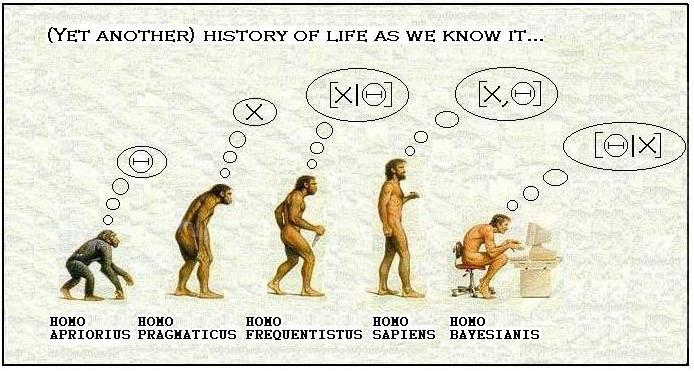
So we as humans adapt to things. That's what we do. We experience, learn, and incorporate what we've learned and then experience-learn-incorporate some more. Each phase of adaptation results in the establishment of a new baseline from which we continue to adapt when presented with new stimuli (incidentally, this is roughly how Bayesian inference, which is a statistical/probabilistic machine learning process, works).

From http://pactiss.org/2011/11/02/bayesian-inference-homo-bayesianis/. Probably more funny to total and absolute nerds. 
What does that mean for us overextended overachievers? Each time we take on a new activity or job, initially we're so jazzed by the new experience and so motivated by learning (which is our favorite. Seriously, your brain and by extension, you, love to learn and can't get enough of that tasty tasty dopamine release that comes with it) that we can forget everything else - sleep, food, sex, pooping, what have you. Once we've adapted to that new activity and it's become a part of our lives and our new baseline for functionality, it continues to be rewarding because there's still the possibility of learning more minute and high-level aspects of the activity, and we remember that gigantic dopaminergic response we got from first experience and initial learning. So we've learned that new activities are rewarding, which leads us to seek them out once we reach the easy-functioning adapted phase in the previous.

So, roughly, my answer to why we take on so damn much: your brain. Your stupid, amazing, awful, vital brain.

Sunday, April 8, 2012

Artists and Technicians

*DISCLAIMER: This post is not intended to offend or piss off or make fun of, but merely to point out some inconsistencies in logic. Also, while I use the terms artist and technician as a dichotomous comparison, I don't mean it in any way as a commentary on technical skill - that's not actually being discussed. This is more about personal goals from involvement in respective creative fields.*

It seems that everyone wants to be an artist these days. Whether your medium is photography, dance, shrubberies, or sandwiches (seriously, the high schoolers that work at Subway are aaaaaaartists), your goal is to be An Artist and to embody that completely in all the things you do.

I have a couple issues with this. First, where is your threshold for defining yourself as an artist? Who decides what that is? An Artist is a binary term: you are either artist or not artist. So someone who is immune to their own scrutiny (or anyone else's) can make dolls out of dried-out orange peels, call it steampunk, post them on Etsy, and consider themselves in company with Vincent Van Gogh and John Lennon. That's...weird.

Second, where does that leave the technicians? There are people in the creative world who are fantastic at executing the work of others faithfully and to perfection. I'll use dance as an example. Most dancers perform the choreography of others rather than generating their own. Your average (non-principal, I guess, although that's up for discussion as well) ballerina in the Kirov, your average American Tribal Style bellydancer, your average Chinese dancer are tasked with faithfully executing the movements with very little of their own interpretation thrown in. To force or ask these technicians to be Artists would be both entirely too much pressure and a slight to the things they actually do well.

So my point is this: we can't ALL be artists, for the same reason that we can't all arbitrarily decide that we're rocket scientists, marine biologists, and physicists. In a field without a formal vetting process and no real qualifications to speak of, the lack of definition in naming convention can destroy the field (e.g., I can't hear the term now without rolling my eyes and retching a little bit and instead prefer to use the word to describe myself when I take a magnificent poo). The implication that we could and should all be artists is an insult to the skills of actual artists, technicians, practitioners, hobbyists, and the rest of the people that make the creative world go 'round.

Thursday, April 5, 2012

"I can do it! I can have it all!"

Tina Fey in 30 Rock, from avclub.com
(Scene described here because I can't find a clip of it and it'll probably get taken down anyways). There's a scene in 30 Rock where Tina Fey's character is stopped at airport security because she has a sandwich. When presented with the choice of leaving it behind so she can go through, she decides to stand there and eat it in the most pitiful way I've ever seen anyone do anything, and yells "I can do it! I can have it all!" through a mouthful of sandwich.

I've recently appropriated this phrase, and I plan to use it as the epitaph on my tombstone when I die because it describes my life perfectly. A friend recently asked me how I was able to teach a workshop, throw a party, attend a grueling practice, work my 10-6 (and beyond) job with a 2 hour daily commute, teach two classes, and then go take workshops and perform twice at a bellydance festival three hours away within a week's space. I shrugged and said I had no idea.

The sad thing is, I'm hardly a rarity in this community and the area in which I live. The DC area and the bellydance community are replete with ridiculous overacheivers like myself, and although I can't begin to understand the reason why we take on so damn much, I have witnessed the effects: The Freaking Plague. We all operate at the absolute edge of our health and immune function as a norm, where the tiniest thing, be it a change in the wind or sick friend or meeting a friend's new cat or the addition of just one more article to write, can launch us headlong into sickness. What follows is an epidemiological nightmare. You can usually chart the spread of disease over social media:
Person A: I have [event] coming up! I'm so stressed but so excited!
Person B: I will be attending/helping out/giving you a plethora of hugs! I'm excited too!
Person A: [Event] is over! I can relax and stop firebombing my fatigued and depleted immune system which has been kept afloat by stress hormones all this time!
Person B: Hooray!
Person A: I'm sick.
Person B: I'm sick.
Person We Didn't Already Know was connected to Person B: I'm sick.
Large Crowd: We're sick!
Ok, so that played out like a Monty Python sketch (get on with it), but you get the picture. For the sake our individual health and that of our society, we need to start applying the gastric bypass band to our lives, and just learn to say "No thanks, I'm full." If not, we'll end up needing witty epitaphs much sooner than we expect.


Ok, that last bit was overly dramatic. I was just trying to tie it all together. I'll just go eat a sandwich instead.

Wednesday, April 4, 2012

Doing what you like and not just what you're good at

I've always been someone who does a lot of things. In elementary school, I played piano, played clarinet, figure skated, did gymnastics, took ballet, took tae kwon do, performed traditional Chinese dance, and attended Chinese school. Then I broke my ankle (funny story - I broke it in gymnastics as I stepped off a high mat AFTER doing crazy stuff on the balance beam). In middle and high school, I dropped all the dance and added volleyball, softball, basketball, choir, theatre, and Girl Scouts to the preexisting piano, clarinet, and Chinese school. Then came college, where I did ABSOLUTELY NOTHING. And it was AMAZING. I'd never given myself a break before, and I'll tell you, that first year was a textbook example of a post-stress slide into sloth. That year I discovered Napster, classic videogame emulators, The Sims, Saturday Night Live reruns in the middle of the day on Comedy Central, sleeping past noon, MTV, and eating ice cream for all meals. I didn't give a second thought to my grades or my body, and as a result, ended up withdrawing from many of my classes after I failed them (known as "Freshman Rule" in my school) and gained about 30 pounds. After that first year, I picked it up, took 16-18 credits each semester, and ended up majoring in psychology with minors in biology (which was only a minor because I refused to take the second semester of organic chemistry) and creative writing, volunteered at the sleep clinic, and worked as a research assistant in my school's biopsychology lab. Following graduation, I picked up where I left off - started playing volleyball and softball again, and got back into dance by regularly taking hip hop, flamenco, and oriental and tribal bellydance, and started performing, all the while working in a law firm, followed by a stint in a bookshop and working in a gym, then becoming a tutor, and then working in non-profit.

And then...something happened. I started to think about how much I was just coasting through my life and how absolutely none of it was making me happy.  I hated my job, my new boss, some of my coworkers, couldn't deal with the drama of being on a volleyball team with a bunch of frustrated women, was totally bored by slow-pitch softball, and met some personalities in dance that I just couldn't stand to be around. It was at that point where I realized how much time and energy I'd invested into doing what I was good at, but not doing what I liked. In fact, I had never thought to even assess whether I liked anything I did. I just did them. So I thought back to how happy I'd been in college after I had normalized into a class-attending, good-grade-receiving, research-doing, and-yet-still-enjoying-television-and-videogames-and-an-occasional-round-of-Star-Wars-Monopoly-that-goes-on-for-6-hours student. And I decided to take a "sabbatical", much to my parents' chagrin. During this time, I thought a lot about what I liked. I liked teaching. I liked dance. And surprisingly, I still liked science! After generally eschewing the stuff following graduation and opting instead for the more "marketable" literary route and basically falling on my ass, I realized that I'd been going about it the wrong way. I should have held out for something science-related, which I would have known if I'd just bothered to touch base with myself.

But why did I spend so much time doing all those things I didn't like that much? My very shameful answer is "other people". In some ways, this makes sense; you get involved in activities when your friends do, or at the behest of your parents, or for "extracurriculars". My involvement in many of these activities had to do with having some level of initial interest perhaps based entirely on the fact that I love novelty and learning, excelling because I learn fast, and being encouraged to continue by teammates, friends, or parents. And obviously, that novelty wears off, and the opinion of others is never enough to sustain interest. After 25+ years of coasting on the respect and opinion of others, I'm finally starting to learn how decide what *I* want to do. Maybe they should call it the "selfish and I like it" 30s. Although that doesn't rhyme.

Tuesday, April 3, 2012

Politics and the Dancing Body exhibit

One of my favorite things in the world is the intersection between art and science/society. This exhibition looks to be a fascinating example of that idea. If I get a chance to go I will surely post my thoughts here. Sigh, I love living in DC.

http://myloc.gov/Exhibitions/politics-and-dance/Pages/default.aspx
From the Library of Congress site: "Through the medium of dance, twentieth-century American choreographers created dances that reflected the diverse spectrum of cultural expression. In addition to works that celebrated America’s traditional music, folk and immigrant practices, and Native American rituals, choreographers were not afraid to craft political dances that protested injustices or advocated reform. Politics and the Dancing Body explores how American choreographers between World War I through the Cold War realized this vision, using dance to celebrate American culture, to voice social protest, and to raise social consciousness.  The exhibition also examines how the U.S. government employed dance as a vehicle for cultural diplomacy and to counter anti-American sentiment. Featuring materials drawn mostly from the rich dance, music, theater, and design collections of the Music Division of the Library of Congress, Politics and the Dancing Body demonstrates how dance was integral to the twentieth-century American cultural and political landscape."

What you can/can't do with a doctorate*

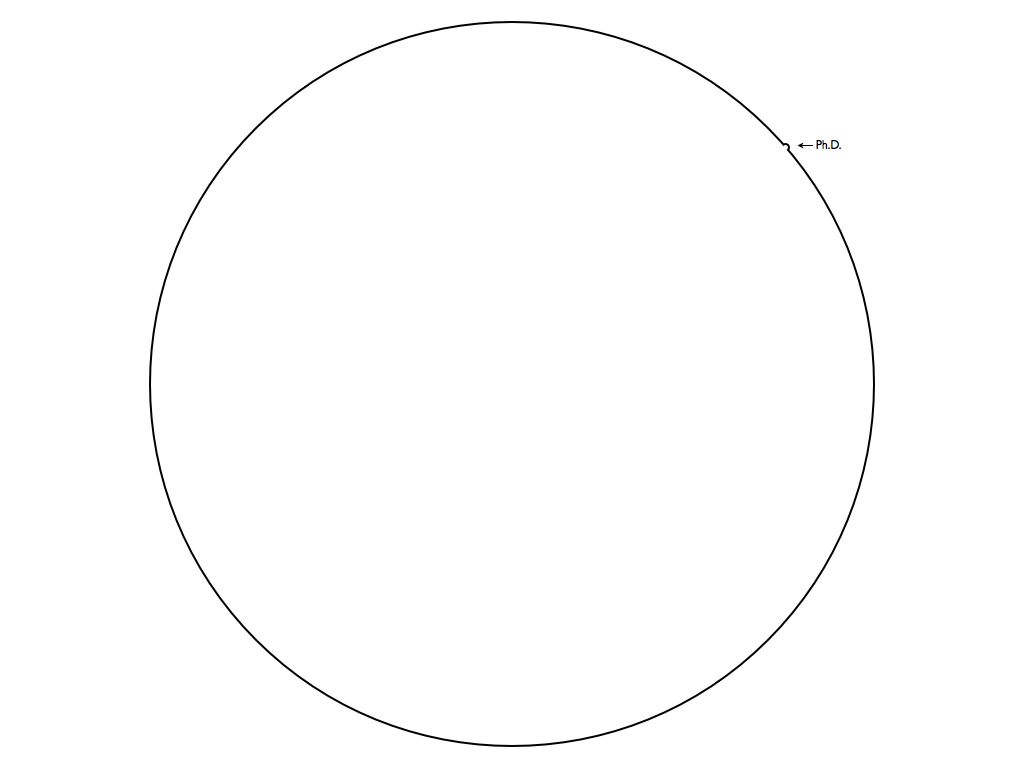
My surname is a homophone of "who", so I've been saying for years now that I'd love to get a doctorate so I can finally fulfill my destiny as Doctor Who. Combine that with a long line of pushy doctorate-having family members and my "inherent sciency-ness" and it probably seems pretty clear where I'm headed. Of course, there are several factors standing in my way, one of which is this: many people with doctorates piss me off.  Please direct your attention to this wonderful infographic:


By Matt Might - the rest of the infographic is here http://matt.might.net/articles/phd-school-in-pictures/#
Having never gone for my PhD, I might not have believed it, if I hadn't encountered SO VERY MANY examples in my life. I seem to be surrounded by people who think that, for example, having PhDs in statistics and math precludes them from ever needing to see a therapist because "I have a PhD too, so they can't tell me anything I don't know", or their PhD in music makes them a calculus expert, or their PhD in engineering instantly makes them able to drive a boat, or their PhD in philosophy makes them fantastic at building IKEA furniture (but while we're on the topic, that degree might incidentally qualify them to be an extra in an existentialist Ingmar Bergman flick...if he were still alive and making movies). Now, I know that PhDs and Superman complexes won't always go hand in hand, but the relationship makes so much sense that I wonder how rare it is. Every single person with a doctorate went through A LOT to get that degree, and likely went through even more to put that degree to work (*cough* postdoc! *cough*) and in a fair world that kind of hard work would be appropriately rewarded. More often than not, that's not the case. Many individuals with doctorates struggle to find work because they're overqualified for most jobs if they don't want to remain in academia, and once they do find work, they'll often do the same work as someone with a lower-level degree and make less money. So it absolutely follows that they'd seek "small victories" elsewhere. Your average disgruntled doctorate-haver-turned-overqualified-office-grunt might attempt to dominate the kitchen, the checkout line at the grocery store, the roads, fields they know nothing about, etc., just to feel like their hard work has gotten them somewhere. And I get it. I really do. And I know you're not all like that. Just don't expect me to be queuing up at the provost's office anytime soon to join you.

*(note: this is in no way intended to be a knock at higher education or anyone with a higher degree - I have a master's degree and really do want my PhD so I can finally work as a scientist, which has been my lifelong dream - I might just need to be a little stronger and wiser and richer and happier with my entire life before I go back to school.)

Self-identity when you love what you do

I have a problem. I love what I do so much, I can't help but describe myself as my profession. When first meeting someone, I typically end up introducing myself by saying "I'm Eugenia, I'm a researcher and/or bellydancer." And it doesn't just stop with me - one of the first things I like to find out about someone is what they do, and I even nicknamed my boyfriend "Chef" (guess what he does). Now, before you judge me for being shallow, I want to state that I believe vocational choices do reflect some aspect of personality or interests, and like any good former psychology student, I usually like to start off with a "profile" of this stranger I'm meeting because I generally dislike unpredictability, and assume that others do too.  I'd also like to think that it's a product of being a DC denizen (and in fact, rare DC native), in a place where everyone is married to their job. And, I really really really love what I do. That really can't be overstated.

However, that doesn't explain how much I'm willing to let what I do "speak" for my identity upon first meeting someone new.  A more likely explanation is my own insecurity, and that manifests in three ways: 1) I'm generally a very private person, and am the most inclined to reveal the least personal aspects of myself upon first meeting, 2) I'm not sure I'm actually GOOD at any of these things that I do, and I want to "prime" my audience by shooting first, and 3) sometimes I just want other people to think I'm cool for being a person with versatile skills. Whatever the reason that I do it, I've learned that I have to de-condition myself and understand that this is dangerous thinking; if I'm what I do, what if that goes away? What if my company goes bust and I get in an accident and become a quadriplegic? What if everything?

From here on out, I vow to view myself as "person who does a thing" rather than "thing itself". I think I should start introducing myself thusly: "I'm Eugenia, I love Doctor Who and candy and spazz out sometimes when I think something is going to fall off the table and shatter and I might be slightly allergic to cats. Oh, and also I do a thing." Because that's better, right?