We've all done it before. We're doing something we've done a million times, like drive home from work, when all of a sudden, our attention fades and we come to. We might be at home, we might be at a favorite bar, we might be at a mate's house - bottom line is, we have no idea how we got there.
This is a phenomenon known as the cognitive failure, or more specifically an attentional lapse, and there are a lot of ways to interpret what that means. It has been used to refer to the failure mentioned above, where your brain recognizes an oft-repeated pattern and (anthropomorphically) goes, "well, I don't need to pay attention anymore." It can also be used to describe the moment during an oft-repeated pattern where your higher cognitive function (i.e., your frontal lobe) tunes back in. A great example of this is when a professional baseball player suddenly fails to field a very standard ground ball. Suddenly, rather than just sitting back and leaving the long-programmed response to its own devices, his frontal lobe is attempting to break down and analyze the process, leading to the kind of fielding errors he'd have made in the early days of Little League. In sports, it's also common to see the moment after an attentional lapse occurs and the athlete panics and tries to catch up. A good example of this is when you see a basketball player instinctively reach for a ball and commit a silly foul. Finally, there is also one of the more severe examples of the attentional lapse seen in the instinctive drowning response. In the last few moments before someone drowns, they stop moving their legs, press their arms down into the water to hold themselves upright, and instinctively gulp air when their noses and mouths are above water and hold their breath when under water. This might sound normal, except when you take into account what this actually looks like: rather than panicking and thrashing about and screaming, the victim silently bobs up and down in the water with a blank facial expression and will not respond to ropes or other rescue devices thrown to them. This situation occurs when the victim's neural system has been so flooded with signals that it can actually no longer respond, which results in autonomic functions taking over.
So what ties all of these things together? All of these situations are marked by a battle or interaction between our higher cognitive function and our primitive lizard brain. It probably looks like this:
<insert picture of a lizard fighting a brain with like, a trident or something here. I'm sure you'll be able to find one on the internets.>
As much as we love to think of our brains as single seamlessly-running units, that is really not the case. Much of our behavior is regulated through the frontal lobe (in general), which is, among other things, in charge of inhibiting the limbic system, which is (also among many other things) our center for the three F's: Fucking Fighting! Fucking Flight-ing! And also fornicating. All jokes aside, the limbic system also regulates essential autonomic functions like breathing and heart rate and generally preventing us from becoming ex-humans. Because these are essential functions for the alive-making, the brain has a general preference for keeping that system functioning even if it doesn't have the energy to expend on the others. That means the frontal lobe, our human-y center of human-y functions like decision-making, planning, expression of emotions, directed motor functions, and information analysis (again, among others) might get the shaft when we're in various states. These states could be dire, such as when we're at risk of drowning, panicked, such as when we're committing silly fouls in basketball, or bored, such as when we end up somewhere we can't remember heading to or make silly fielding errors. In all of these situations, the "prime" function shifts back and forth between the higher cognitive functions of the frontal lobe and the primitive functions of the limbic system.
So why is all that relevant? Well, it sort of underscores a point about the fallibility of our neural function as it relates to attention and everyday activities (and well...non-everyday activities in terms of the drowning) and the idea of self-control. As much as it becomes a defense in murder cases, we are often NOT in total control of our actions, and sometimes we just have to live (or...not live) with that.
Wednesday, May 30, 2012

Monday, May 21, 2012
Women in Science - The Importance of a Mentor

A while back, the subject of women in science came up, and I suggested that it was easier to sustain the attention of boys than girls in science. I know it is not in any way the PC thing to say, but based on my experience this seems to be the case.
Now when I say this I'm not talking about interest in science, which anyone can have (and if I have anything to say about it EVERYONE should have), I'm talking specifically about what it takes to be a scientist, meaning the focus and energy necessary to obtain PhDs and regularly generate new research and publish on a regular basis and hold professorships. When it comes down to it, you DO see far fewer women than men doing these things. And I think there are several mechanisms at work here. One of the factors I see that has lent itself to this disparity, that I have spent years trying to work on, is the ability to mercilessly tear both others' and your own work to shreds. And the other, the one that makes me the saddest if it's true, the reason that there are fewer women TO be merciless, is the relative importance of finding a mentor that can set an example to guide them.
The Mentor
You could say several things in response to this issue. 1 - there are so few women in science anyways that it would be hard to find a female mentor that they can relate to if that's what they need; 2 - don't men need mentors too?; 3 - you should just shut up your prejudiced ass, there's no problem, and you're wrong. In response to the first, I have actually worked in a lab with a female principle investigator (PI) and I can say that just finding another female is not enough. There were three PhD students in this lab, two men and one woman, and two undergraduate research assistants, one male and one female (me). I worked closely with one of the male PhD students, the female PhD student, and the male RA, and by the end of the 2nd semester, both the female PhD student and I had left because of lack of guidance from the PI. The male PhD student and RA stayed on.
Of course, this is not to say that the mentor has to be female. I had a wonderful working relationship with my graduate advisor. The other master's student (male) and I both found our needs perfectly served by our brilliant and laid-back PI, as we were both highly self-motivated and had lots and lots of ideas. Our advisor helped to groom and streamline our ideas, and we both left the program with our degrees and the motivation to continue in the field. However, our experiences might not have been equivalent to many others. Among the students, we'd had a long string of males that have graduated with PhDs, either from our lab or sent off to get PhDs from different schools after completing undergrad and master's programs there. The women...not so successful. I believe we'd had a string of female master's students that had successfully graduated, but one female PhD student was infamously asked to leave the program after a couple years, and the most recent (female) PhD student did not seem entirely happy with the lab or her advisor.
To answer the second question, in my observations, men don't seem as affected by mentors as women. I've seen plenty of male students who dislike/don't get along with/don't connect with their advisors graduate. Of course, there are some more dramatic examples of male interactions with their advisors (here and here), and rather than discard them as outliers, I think I'd suggest that males might stick around in programs in spite of their mentors up to a certain threshold, after which extreme behavior might occur.
To address the final question/indignant statement, I've found a few sources that suggest that females drop out of PhD programs at a higher rate than men (here and here). And all you need to do is look around to see the systemic issue plaguing the scientific community and country at large and yell my favorite accidental slogan in recent memory: WHERE ARE THE WOMEN? (and believe me, this will be discussed in detail at a later date.)
The Quality of Mercy
In most talks and lectures I went to as a master's student, it was the males that were shooting off questions, poking holes in the ideas of the presenters, and generally being the most vocal. This would likely not surprise many of you. The thing is, I often saw a few women of comparable educational background and research experience in the room nodding their heads in agreement when their male colleagues asked questions or made comments. If they were thinking it too, what stopped them from asking it? SPEAK UP LADY, WE CAN'T HEAR YOU.
I took a class in Cognitive Modeling/Artificial Neural Networks in grad school that completely changed my life. The subject matter was fantastic, and the discussion-based format was wonderful, but the thing that really blew me away was my classmates. At least 50% of my classmates were female, and they were by far the most vocal (with the exception of this dude named Pavel, who was brilliant if a little bit anarchic and loved playing devil's advocate. I thought he was hilarious. The rest of the class didn't). They asked questions, they poked holes, and what's more important, they had no problem either disagreeing with the entire class (including the teacher) or showing that they might not be getting it. About halfway through the semester, you could practically see the shock on the professor's face at the fact that this group of female neuroscience students was basically running his class. And he loved it (we all ended up with A's).
So what's going on here? I haven't yet figured it out completely, but I've noticed something - it all goes back to the mentor. The female students I respected the most in my school had...well, for lack of a better word, assholes as advisors. These principle investigators were fiercely intelligent, intimidating, and would shut you down if you were wrong, no matter who or where you were. So as a result, their students developed thicker skin, and did away with their own social appropriateness (or "good girl") filters. There is no doubt in my mind that these women will become the next generation of prolific publishers and researchers. Even I, after participating in seminars and discussions with them, (and generally being peer-mentored by them, if only by example and interaction) found my skin getting thicker and my filter fading away. Nowadays, I will come out and say it whenever I think anyone is wrong no matter who they are, and if they think I'm wrong, that's totally fine. When it comes down to it, I don't find many women being able to stick their necks out to the extent that these women did, and that's what you really need to be a scientist.
Saturday, April 14, 2012
Adaptation and new baselines
Ok, so this is my first attempt at explaining why we do too many things. I'm sure my ideas will develop and evolve as I continually gather information - but believe me, this is an issue that's close to my heart and I want to get it right.
So we as humans adapt to things. That's what we do. We experience, learn, and incorporate what we've learned and then experience-learn-incorporate some more. Each phase of adaptation results in the establishment of a new baseline from which we continue to adapt when presented with new stimuli (incidentally, this is roughly how Bayesian inference, which is a statistical/probabilistic machine learning process, works).
What does that mean for us overextended overachievers? Each time we take on a new activity or job, initially we're so jazzed by the new experience and so motivated by learning (which is our favorite. Seriously, your brain and by extension, you, love to learn and can't get enough of that tasty tasty dopamine release that comes with it) that we can forget everything else - sleep, food, sex, pooping, what have you. Once we've adapted to that new activity and it's become a part of our lives and our new baseline for functionality, it continues to be rewarding because there's still the possibility of learning more minute and high-level aspects of the activity, and we remember that gigantic dopaminergic response we got from first experience and initial learning. So we've learned that new activities are rewarding, which leads us to seek them out once we reach the easy-functioning adapted phase in the previous.
So, roughly, my answer to why we take on so damn much: your brain. Your stupid, amazing, awful, vital brain.
So we as humans adapt to things. That's what we do. We experience, learn, and incorporate what we've learned and then experience-learn-incorporate some more. Each phase of adaptation results in the establishment of a new baseline from which we continue to adapt when presented with new stimuli (incidentally, this is roughly how Bayesian inference, which is a statistical/probabilistic machine learning process, works).
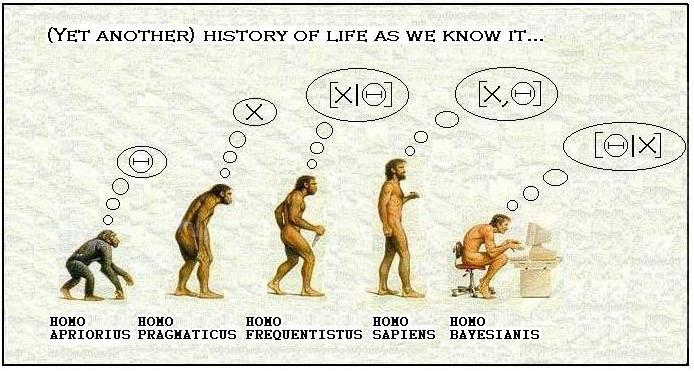 |
| From http://pactiss.org/2011/11/02/bayesian-inference-homo-bayesianis/. Probably more funny to total and absolute nerds. |
So, roughly, my answer to why we take on so damn much: your brain. Your stupid, amazing, awful, vital brain.
Sunday, April 8, 2012
Artists and Technicians
*DISCLAIMER: This post is not intended to offend or piss off or make fun of, but merely to point out some inconsistencies in logic. Also, while I use the terms artist and technician as a dichotomous comparison, I don't mean it in any way as a commentary on technical skill - that's not actually being discussed. This is more about personal goals from involvement in respective creative fields.*
It seems that everyone wants to be an artist these days. Whether your medium is photography, dance, shrubberies, or sandwiches (seriously, the high schoolers that work at Subway are aaaaaaartists), your goal is to be An Artist and to embody that completely in all the things you do.
I have a couple issues with this. First, where is your threshold for defining yourself as an artist? Who decides what that is? An Artist is a binary term: you are either artist or not artist. So someone who is immune to their own scrutiny (or anyone else's) can make dolls out of dried-out orange peels, call it steampunk, post them on Etsy, and consider themselves in company with Vincent Van Gogh and John Lennon. That's...weird.
Second, where does that leave the technicians? There are people in the creative world who are fantastic at executing the work of others faithfully and to perfection. I'll use dance as an example. Most dancers perform the choreography of others rather than generating their own. Your average (non-principal, I guess, although that's up for discussion as well) ballerina in the Kirov, your average American Tribal Style bellydancer, your average Chinese dancer are tasked with faithfully executing the movements with very little of their own interpretation thrown in. To force or ask these technicians to be Artists would be both entirely too much pressure and a slight to the things they actually do well.
So my point is this: we can't ALL be artists, for the same reason that we can't all arbitrarily decide that we're rocket scientists, marine biologists, and physicists. In a field without a formal vetting process and no real qualifications to speak of, the lack of definition in naming convention can destroy the field (e.g., I can't hear the term now without rolling my eyes and retching a little bit and instead prefer to use the word to describe myself when I take a magnificent poo). The implication that we could and should all be artists is an insult to the skills of actual artists, technicians, practitioners, hobbyists, and the rest of the people that make the creative world go 'round.
It seems that everyone wants to be an artist these days. Whether your medium is photography, dance, shrubberies, or sandwiches (seriously, the high schoolers that work at Subway are aaaaaaartists), your goal is to be An Artist and to embody that completely in all the things you do.
I have a couple issues with this. First, where is your threshold for defining yourself as an artist? Who decides what that is? An Artist is a binary term: you are either artist or not artist. So someone who is immune to their own scrutiny (or anyone else's) can make dolls out of dried-out orange peels, call it steampunk, post them on Etsy, and consider themselves in company with Vincent Van Gogh and John Lennon. That's...weird.
Second, where does that leave the technicians? There are people in the creative world who are fantastic at executing the work of others faithfully and to perfection. I'll use dance as an example. Most dancers perform the choreography of others rather than generating their own. Your average (non-principal, I guess, although that's up for discussion as well) ballerina in the Kirov, your average American Tribal Style bellydancer, your average Chinese dancer are tasked with faithfully executing the movements with very little of their own interpretation thrown in. To force or ask these technicians to be Artists would be both entirely too much pressure and a slight to the things they actually do well.
So my point is this: we can't ALL be artists, for the same reason that we can't all arbitrarily decide that we're rocket scientists, marine biologists, and physicists. In a field without a formal vetting process and no real qualifications to speak of, the lack of definition in naming convention can destroy the field (e.g., I can't hear the term now without rolling my eyes and retching a little bit and instead prefer to use the word to describe myself when I take a magnificent poo). The implication that we could and should all be artists is an insult to the skills of actual artists, technicians, practitioners, hobbyists, and the rest of the people that make the creative world go 'round.
Thursday, April 5, 2012
"I can do it! I can have it all!"
 |
| Tina Fey in 30 Rock, from avclub.com |
I've recently appropriated this phrase, and I plan to use it as the epitaph on my tombstone when I die because it describes my life perfectly. A friend recently asked me how I was able to teach a workshop, throw a party, attend a grueling practice, work my 10-6 (and beyond) job with a 2 hour daily commute, teach two classes, and then go take workshops and perform twice at a bellydance festival three hours away within a week's space. I shrugged and said I had no idea.
The sad thing is, I'm hardly a rarity in this community and the area in which I live. The DC area and the bellydance community are replete with ridiculous overacheivers like myself, and although I can't begin to understand the reason why we take on so damn much, I have witnessed the effects: The Freaking Plague. We all operate at the absolute edge of our health and immune function as a norm, where the tiniest thing, be it a change in the wind or sick friend or meeting a friend's new cat or the addition of just one more article to write, can launch us headlong into sickness. What follows is an epidemiological nightmare. You can usually chart the spread of disease over social media:
Person A: I have [event] coming up! I'm so stressed but so excited!Ok, so that played out like a Monty Python sketch (get on with it), but you get the picture. For the sake our individual health and that of our society, we need to start applying the gastric bypass band to our lives, and just learn to say "No thanks, I'm full." If not, we'll end up needing witty epitaphs much sooner than we expect.
Person B: I will be attending/helping out/giving you a plethora of hugs! I'm excited too!
Person A: [Event] is over! I can relax and stop firebombing my fatigued and depleted immune system which has been kept afloat by stress hormones all this time!
Person B: Hooray!
Person A: I'm sick.
Person B: I'm sick.
Person We Didn't Already Know was connected to Person B: I'm sick.
Large Crowd: We're sick!
Ok, that last bit was overly dramatic. I was just trying to tie it all together. I'll just go eat a sandwich instead.
Wednesday, April 4, 2012
Doing what you like and not just what you're good at
I've always been someone who does a lot of things. In elementary school, I played piano, played clarinet, figure skated, did gymnastics, took ballet, took tae kwon do, performed traditional Chinese dance, and attended Chinese school. Then I broke my ankle (funny story - I broke it in gymnastics as I stepped off a high mat AFTER doing crazy stuff on the balance beam). In middle and high school, I dropped all the dance and added volleyball, softball, basketball, choir, theatre, and Girl Scouts to the preexisting piano, clarinet, and Chinese school. Then came college, where I did ABSOLUTELY NOTHING. And it was AMAZING. I'd never given myself a break before, and I'll tell you, that first year was a textbook example of a post-stress slide into sloth. That year I discovered Napster, classic videogame emulators, The Sims, Saturday Night Live reruns in the middle of the day on Comedy Central, sleeping past noon, MTV, and eating ice cream for all meals. I didn't give a second thought to my grades or my body, and as a result, ended up withdrawing from many of my classes after I failed them (known as "Freshman Rule" in my school) and gained about 30 pounds. After that first year, I picked it up, took 16-18 credits each semester, and ended up majoring in psychology with minors in biology (which was only a minor because I refused to take the second semester of organic chemistry) and creative writing, volunteered at the sleep clinic, and worked as a research assistant in my school's biopsychology lab. Following graduation, I picked up where I left off - started playing volleyball and softball again, and got back into dance by regularly taking hip hop, flamenco, and oriental and tribal bellydance, and started performing, all the while working in a law firm, followed by a stint in a bookshop and working in a gym, then becoming a tutor, and then working in non-profit.
And then...something happened. I started to think about how much I was just coasting through my life and how absolutely none of it was making me happy. I hated my job, my new boss, some of my coworkers, couldn't deal with the drama of being on a volleyball team with a bunch of frustrated women, was totally bored by slow-pitch softball, and met some personalities in dance that I just couldn't stand to be around. It was at that point where I realized how much time and energy I'd invested into doing what I was good at, but not doing what I liked. In fact, I had never thought to even assess whether I liked anything I did. I just did them. So I thought back to how happy I'd been in college after I had normalized into a class-attending, good-grade-receiving, research-doing, and-yet-still-enjoying-television-and-videogames-and-an-occasional-round-of-Star-Wars-Monopoly-that-goes-on-for-6-hours student. And I decided to take a "sabbatical", much to my parents' chagrin. During this time, I thought a lot about what I liked. I liked teaching. I liked dance. And surprisingly, I still liked science! After generally eschewing the stuff following graduation and opting instead for the more "marketable" literary route and basically falling on my ass, I realized that I'd been going about it the wrong way. I should have held out for something science-related, which I would have known if I'd just bothered to touch base with myself.
But why did I spend so much time doing all those things I didn't like that much? My very shameful answer is "other people". In some ways, this makes sense; you get involved in activities when your friends do, or at the behest of your parents, or for "extracurriculars". My involvement in many of these activities had to do with having some level of initial interest perhaps based entirely on the fact that I love novelty and learning, excelling because I learn fast, and being encouraged to continue by teammates, friends, or parents. And obviously, that novelty wears off, and the opinion of others is never enough to sustain interest. After 25+ years of coasting on the respect and opinion of others, I'm finally starting to learn how decide what *I* want to do. Maybe they should call it the "selfish and I like it" 30s. Although that doesn't rhyme.
And then...something happened. I started to think about how much I was just coasting through my life and how absolutely none of it was making me happy. I hated my job, my new boss, some of my coworkers, couldn't deal with the drama of being on a volleyball team with a bunch of frustrated women, was totally bored by slow-pitch softball, and met some personalities in dance that I just couldn't stand to be around. It was at that point where I realized how much time and energy I'd invested into doing what I was good at, but not doing what I liked. In fact, I had never thought to even assess whether I liked anything I did. I just did them. So I thought back to how happy I'd been in college after I had normalized into a class-attending, good-grade-receiving, research-doing, and-yet-still-enjoying-television-and-videogames-and-an-occasional-round-of-Star-Wars-Monopoly-that-goes-on-for-6-hours student. And I decided to take a "sabbatical", much to my parents' chagrin. During this time, I thought a lot about what I liked. I liked teaching. I liked dance. And surprisingly, I still liked science! After generally eschewing the stuff following graduation and opting instead for the more "marketable" literary route and basically falling on my ass, I realized that I'd been going about it the wrong way. I should have held out for something science-related, which I would have known if I'd just bothered to touch base with myself.
But why did I spend so much time doing all those things I didn't like that much? My very shameful answer is "other people". In some ways, this makes sense; you get involved in activities when your friends do, or at the behest of your parents, or for "extracurriculars". My involvement in many of these activities had to do with having some level of initial interest perhaps based entirely on the fact that I love novelty and learning, excelling because I learn fast, and being encouraged to continue by teammates, friends, or parents. And obviously, that novelty wears off, and the opinion of others is never enough to sustain interest. After 25+ years of coasting on the respect and opinion of others, I'm finally starting to learn how decide what *I* want to do. Maybe they should call it the "selfish and I like it" 30s. Although that doesn't rhyme.
Tuesday, April 3, 2012
Politics and the Dancing Body exhibit
One of my favorite things in the world is the intersection between art and science/society. This exhibition looks to be a fascinating example of that idea. If I get a chance to go I will surely post my thoughts here. Sigh, I love living in DC.
 http://myloc.gov/Exhibitions/politics-and-dance/Pages/default.aspx

From the Library of Congress site: "Through the medium of dance, twentieth-century American choreographers created dances that reflected the diverse spectrum of cultural expression. In addition to works that celebrated America’s traditional music, folk and immigrant practices, and Native American rituals, choreographers were not afraid to craft political dances that protested injustices or advocated reform. Politics and the Dancing Body explores how American choreographers between World War I through the Cold War realized this vision, using dance to celebrate American culture, to voice social protest, and to raise social consciousness. The exhibition also examines how the U.S. government employed dance as a vehicle for cultural diplomacy and to counter anti-American sentiment. Featuring materials drawn mostly from the rich dance, music, theater, and design collections of the Music Division of the Library of Congress, Politics and the Dancing Body demonstrates how dance was integral to the twentieth-century American cultural and political landscape."
Subscribe to:
Posts (Atom)